Eloping in Ireland 2026: The Definitive Guide for U.S. Couples
Last Updated February 16th 2026 – Reviewed for UK ETA changes (effective 25 Feb 2026)
Written by Rob Dight, Ireland-based elopement photographer and planning guide. Trusted by 300+ U.S. couples since 2014. Based on the Causeway Coast, Northern Ireland.
Eloping in Ireland isn’t just a wedding choice — it’s a decision to step away from pressure, expectations, and the stress of a traditional $60,000 wedding. Instead of planning a single, hectic day for everyone else, you create an experience that’s entirely about the two of you.
This is more than a ceremony. It’s an elopement and honeymoon combined into one unforgettable trip, set among ancient coastlines, wild landscapes, and quiet moments that actually feel meaningful. No seating charts. No performance. Just presence, freedom, and space to celebrate your relationship in a way that feels true to who you are.
This guide exists to simplify the process—from legal requirements to hidden locations—so you can design an elopement in Ireland that feels intentional, calm, and deeply personal.
Working with an experienced Ireland-based elopement photographer removes most of the logistical stress before you even arrive.
What follows is a clear, experience-led framework for planning an Ireland elopement that remains calm, flexible, and deeply personal from beginning to end.
TL;DR – What Most U.S. Couples Actually Choose in 2026
- Ceremony: Symbolic
(Most U.S. couples legally marry at home and choose a symbolic ceremony in Ireland for full location freedom.) - Primary Region: The Causeway Coast, Northern Ireland
- Travel Alert: UK ETA mandatory from 25 February 2026
- Notice Buffer: 10–12 weeks strongly recommended for legal paths
- Strategy: Prioritise location density to minimise driving and maximise the day
Still deciding where in Ireland feels most like you?
Start with the location map first: → Best Places to Elope in Ireland (2026 Location Guide)
Then return here to build the legal, timing, and travel plan.
EST. 2014
Why Trust This Guide
More Than A Decade of Experience Guiding U.S. Couples to Elope in Ireland
I photographed my first Irish elopement in 2014 for a couple traveling from the U.S., without realizing it would completely reshape how I approach weddings. Watching them move through the landscape with total freedom made something clear very quickly: elopements aren’t just smaller weddings — they are a fundamentally different experience.
Over the decade since, I’ve spent countless days exploring Ireland’s Atlantic coastline and the quieter corners of the North, learning how to plan around shifting weather, light, tides, and terrain. That experience means my couples don’t need to worry about logistics or conditions on the day — they can simply be present, knowing everything has been carefully thought through.
I work as a true boots-on-the-ground partner for U.S. couples eloping in Ireland, combining over 11 years of local experience with a clear, proven planning process. Planning from 3,000 miles away brings unique challenges — time zones, unfamiliar vendors, weather, and legal requirements — and my role is to remove that complexity before it ever reaches you. By the time you arrive in Ireland, every detail has already been carefully considered, allowing you to step into your elopement day calm, confident, and fully present with each other. If you’re still comparing options, this framework on how to choose an Ireland elopement photographer will help you make the right decision before you book anyone.
Your boots-on-the-Ground Partner for an Effortless Irish Elopement
Ian & Kelly’s experience is exactly what I strive for with every couple—moving beyond the stress of logistics so you can focus on the moment. That sense of calm doesn’t happen by accident. Over more than a decade, I’ve refined the process behind it into three essential pillars of planning.
The Three Pillars of Planning Your Ireland Elopement
Master the Legal Logistics
While Ireland requires advance notice and specific legal steps for civil ceremonies, the vast majority of U.S. couples legally marry at home and choose a symbolic ceremony in Ireland. This approach removes friction and preserves flexibility.
By choosing a symbolic ceremony in Ireland, couples gain:
Full Location Freedom
Say your vows anywhere — from a secluded cliff edge to a centuries-old ruin — without being limited to licensed venues.
No On-the-Ground Red Tape
No government appointments, residency requirements, or registrar schedules once you arrive.
Complete Privacy
No officials, no formalities — just the two of you and the landscape.
For couples who want to understand both routes clearly, I break down the legal and symbolic options in detail here:
Master the Timing & Light
Great elopements aren’t built around fixed schedules. They’re built around light, weather patterns, and crowd behaviour. This is where experience makes the difference between a stressful day and a cinematic one.
How timing is planned in practice:
Strategic Light Planning
Ceremonies are timed for sunrise or late evening, when light is softer, warmer, and far more forgiving than midday conditions.
Golden & Blue Hour Flow
From warm golden light to the deep, atmospheric tones of blue hour, timelines are designed to let the landscape evolve naturally around you.
Built-In Crowd Avoidance
By avoiding peak hours, couples experience iconic locations in near solitude — not alongside tour buses and foot traffic.
This approach doesn’t fight Ireland’s conditions.
It works with them.
Master the Locations
After more than a decade of scouting, I’ve learned which locations hold up in real conditions, which ones fail under pressure, and which rarely photographed places quietly outperform the famous icons.
Location planning focuses on:
Access & Permissions
Where required, I manage landowner permissions and local logistics so ceremonies remain respectful, discreet, and uninterrupted.
Shelter & Geography
Cliffs, coves, ruins, and headlands are chosen with wind direction, exposure, and natural shelter in mind — not just aesthetics.
Density & Flow
The best regions allow multiple world-class locations within short distances, reducing driving and keeping the day calm and immersive.
This is why certain regions — particularly the Causeway Coast — consistently deliver better elopement experiences than more famous but fragmented areas.
→ How to choose an elopement photographer in Ireland (and why local judgment matters more than style)
A Real Ireland Elopement on the Causeway Coast (March 2025)
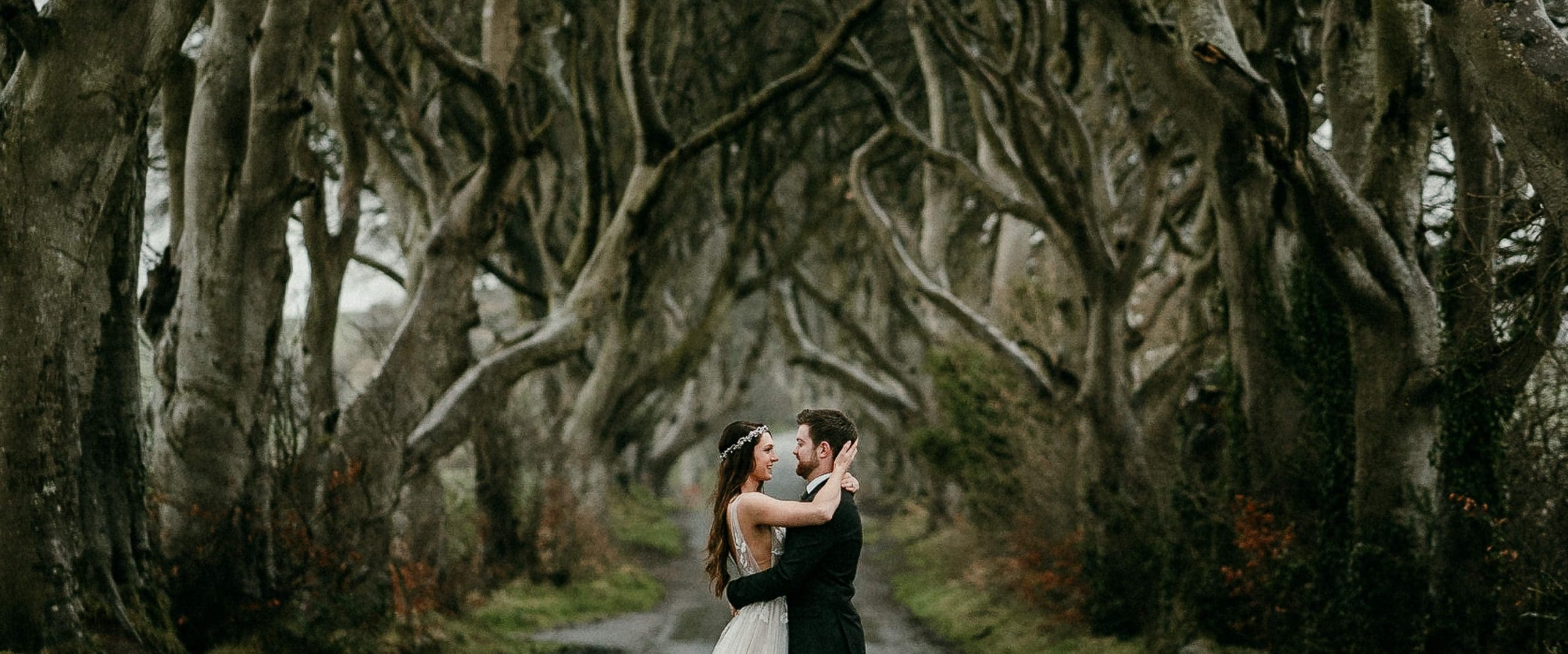
This is a real elopement shot on the Causeway Coast in Northern Ireland — no models, no staging, no styled shoot. Just a calm, intentional day in one of Ireland’s most dramatic landscapes.
Where To Elope in Ireland
Where Couples Actually Elope in Ireland (Scenic Overview)
Choosing the right landscape is the first real decision — but this page is the planning manual, not the location catalogue.
If you want a curated breakdown of Ireland’s best regions, cliff systems, and “vibe-based” location options (with exact examples), start here:
→ Best Places to Elope in Ireland (2026 Location Guide)
Below is the brief strategic overview of where most Ireland elopements take place, followed by the scorecard that helps you choose a region based on logistics, not hype.
In practice, most elopements fall into just a handful of scenic regions across Ireland and Northern Ireland.
Rather than listing every option here, this guide focuses on the strategic comparison between regions — privacy, logistics, travel efficiency, and weather resilience.
If you want the “which region fits us?” answer quickly, use the scorecard below. If you want the actual location options within each region, use the Best Places guide linked above.
Strategic Comparison: The Elopement Region Scorecard
Choosing a region is about balancing the visual “epicness” against the physical reality of the day. In this scale, 10 is always the best possible result.
This scorecard is about planning mechanics (density, shelter, driving) — not a list of specific ceremony spots.
| Region | Epicness | Crowd Avoidance | Location Density | Travel Efficiency | Weather Shelter |
| Causeway Coast | 10 | 8 | 10 | 10 | 9 |
| County Kerry | 10 | 6 | 5 | 4 | 5 |
| Cliffs of Moher | 10 | 3 | 1 | 6 | 1 |
| Donegal | 9 | 10 | 4 | 3 | 4 |
| Wicklow Mountains | 7 | 7 | 6 | 8 | 1 |
The Breakdown of the Scores:
- Epicness: Measures the “wow” factor of the raw landscape. Kerry and the Causeway Coast consistently score perfectly for their dramatic scale.
- Crowd Avoidance: Higher scores mean it is easier to find total privacy. Donegal is the gold standard for solitude , while the Cliffs of Moher score lowest due to their status as a major tourist hub.
- Location Density: Measures how many “epic” backdrops you can reach without long drives. The Causeway Coast wins because its ruins and cliffs are clustered together. The Cliffs of Moher score a 1 because reaching a secondary site like Corcomroe Abbey is a 45-minute drive.
- Travel Efficiency: A high score means less time spent in the car. In Donegal or Kerry, spots are often nearly an hour apart on narrow roads.
- Weather Shelter: Measures the availability of backup options (caves, ruins, or sheltered coves). The Causeway Coast scores highest due to its natural geography. Both Wicklow and the Cliffs of Moher score a 1 because they offer almost no natural shelter and are highly exposed to the elements.
This comparison isn’t about scenery — Ireland has beauty everywhere.
It’s about which regions consistently hold up in real conditions when weather shifts, timelines compress, and privacy matters most.
That is the difference between choosing a beautiful place and choosing a place that actually works on the day.
Who This Guide Is For (and Who It Isn’t)
This is for couples who value experience over performance, want privacy and meaning rather than chair covers, and are happy to invest properly to avoid regret.
If you’re searching for the cheapest way to elope in Ireland, this isn’t your guide — and I’m not your photographer.
If you’re still weighing options, start with my how to choose an elopement photographer in Ireland framework, which explains what actually matters beyond price and pretty photos.
“Nothing felt lonely — it felt focused.”
My Role: What You’re Actually Buying
Authority Summary
Rob Dight has guided 300+ U.S. couples from all 50 states through elopements in Ireland and Northern Ireland since 2014. His role combines photography, location strategy, and real-time decision-making to create calm, experience-led elopements that hold up under real Irish conditions.
Experience that reduces risk
This isn’t just photography.
It’s on-the-ground decision-making in real Irish conditions.
Since 2014, I’ve guided more than 300 U.S. couples through elopements across Ireland and Northern Ireland. My role is simple: remove uncertainty before it ever reaches you.
Ireland’s landscapes are exposed and fast-changing. Wind direction, cloud movement, tide timing, access restrictions, and light quality all determine whether a location actually works on the day. Many popular, Pinterest-famous spots fail under real conditions. Others quietly excel.
I plan around that reality.
I design timelines that prioritise light, shelter, privacy, and travel efficiency.
I choose locations that hold up when weather shifts.
I build backup options that don’t feel like compromises.
This experience matters because Ireland rewards informed planning, not rigid plans.
“A well-planned Irish elopement doesn’t rely on luck — it’s designed to absorb uncertainty and still deliver something extraordinary.”
When I build an elopement day, it isn’t just aesthetic.
It’s resilient.
Expert Reality Check: Planning in Real Irish Conditions
Ireland isn’t dangerous — but it is changeable.
Wind, weather, light, and tides can all shift quickly. That doesn’t ruin days, but it does reward flexibility and calm decision-making.
When Brian & Laura eloped, a sudden gust lifted Laura’s veil clean off her shoulders and carried it straight out over a 200-foot cliff. It was gone in seconds. They laughed, adjusted, and carried on — and it became one of those stories they now tell with a smile.
The goal isn’t to prevent the elements.
It’s to plan in a way that absorbs them without stress.
Case Study: The 24-Hour Storm Pivot (Miquel & David)
Miquel and David planned an intimate afternoon elopement on the Causeway Coast, carefully timed for soft Atlantic light.
The day before their elopement, the forecast escalated from “unsettled” to a full Atlantic storm — a fast-moving system with sustained winds that would have made exposed clifftops the wrong place to be.
Here’s what didn’t happen:
- I didn’t forward weather app screenshots
- I didn’t burden them with decisions they shouldn’t have had to make
- I didn’t let uncertainty bleed into their experience
Instead, I made the call and rebuilt the plan.
By 6:00 p.m. the evening before, I had:
- Identified a storm-sheltered, east-facing location with reliable sunrise light
- Secured access and permissions
- Rebuilt the entire day around a 6:00 a.m. ceremony, ahead of the storm’s arrival
- Coordinated every vendor so no one had to improvise under pressure
Only once the plan was completely locked did I call Miquel and David.
I explained the storm clearly, showed them one image of the alternative location, and said:
“If you trust me, set your alarms. This will be better than Plan A.”
They trusted the process.
At first light, they exchanged vows alone on a quiet beach as the sky softened into pale pinks and golds. The wind never reached them. The storm stayed offshore.
By the time the rain hit land, they were already back at their accommodation — wrapped in blankets, drinking coffee, and laughing at how unreal the morning felt.
“It never felt like a backup plan. It felt like the day was designed exactly for us.”
— Miquel & David, Utah, USA
Why the North First: Strategic Comparisons
While the Republic of Ireland offers iconic landmarks, Northern Ireland offers a rare combination of dramatic scenery, lighter bureaucracy, and genuine flexibility.
Here’s how the two jurisdictions compare for overseas couples:
| Aspect | Republic of Ireland | Northern Ireland (Causeway Coast) |
| Notice Period | 3 months (strict) | 28 days (10–12 weeks recommended) |
| Outdoor Freedom | Very restricted | High (with landowner permission) |
| Crowds at Top Spots | High (Cliffs of Moher, etc.) | Low–Medium |
| Most U.S. Couples Choose | Iconic but busy | Yes — symbolic & private |
Best Region Strategy: Why the Causeway Coast Wins for Most U.S. Couples
If your priority is a day that feels cinematic but calm, the Causeway Coast is the most reliable choice on the island — not because it’s “prettier,” but because it has the best planning mechanics.
This isn’t a “top places” claim — it’s a planning mechanics claim: density + shelter + flexibility create the calmest, most resilient elopement days.
Here’s the strategic advantage:
- Location density: world-class cliffs, ruins, beaches, and sea caves are often 10–15 minutes apart.
- Travel efficiency: less driving = more time actually experiencing your wedding day.
- Weather resilience: the coastline has real shelter options (coves, caves, ruins, headlands with wind shadow) so a shift in conditions doesn’t collapse the plan.
- Privacy potential: even near iconic landmarks, it’s possible to build moments that feel quiet and uninterrupted with the right timing and access choices.
If you want the full location index (east → west) and the exact spots I use in real elopement timelines, start here:
→ Causeway Coast Elopement Locations (Northern Ireland Guide)
If you’re still deciding between regions and want the broader “map” view first:
→ Best Places to Elope in Ireland (2026 Guide)
Best Time of Year to Elope in Ireland
There’s no single “best” month to elope in Ireland — but there are better trade-offs depending on what you value most.
- April–May: Fresh greens, longer days returning, fewer tourists
- June–August: Longest daylight (sunset after 10 p.m.), warmer temperatures, busier locations
- September–October: Softer light, fewer crowds, excellent balance overall
- November–March: Moody skies, short days, maximum privacy, weather-dependent
Many experienced planners quietly favour May, September, and early October for the best balance of light, atmosphere, and calm.
Weather & Temperatures: What to Actually Expect
Ireland’s weather is changeable rather than extreme. What matters most isn’t temperature — it’s wind direction, cloud movement, and exposure.
Typical temperatures:
- Spring / Autumn: 10–15°C (50–60°F)
- Summer: 15–20°C (60–68°F)
- Winter: 5–10°C (40–50°F)
Snow is rare. Heatwaves are uncommon. Wind is the biggest variable, particularly on the coast — which is why location choice and timeline planning matter more than obsessing over forecasts.
If you’re considering a colder-season elopement, this guide on how to stay warm during a winter elopement in Ireland explains how couples stay comfortable without sacrificing style or experience.
Travel & Planning Logistics
⚠️ Critical 2026 Travel Requirement: The UK ETA
From 25 February 2026, every U.S. citizen needs a UK Electronic Travel Authorisation (ETA) to enter Northern Ireland.
- You need this even if you fly into Dublin and drive north
- No ETA = airlines will deny boarding
- Cost: ~£16, valid for multiple visits over 2 years
Action: Apply online via GOV.UK or the UK ETA app.
Full step-by-step guidance:
UK ETA for Northern Ireland elopements – 2026 guide
Best Airports for U.S. Couples Eloping in Ireland
Choosing the right airport can simplify your entire trip.
- Dublin Airport — most U.S. direct flights, best overall flexibility
- Belfast International Airport — shortest drive to the Causeway Coast
- Shannon Airport — quieter access to the west coast
Important:
If your elopement is in Northern Ireland, UK ETA rules apply regardless of where you land.
Witnesses, Officiants & Ceremony Structure
Symbolic ceremonies do not require witnesses or a legally registered officiant.
Legal ceremonies require:
- Two adult witnesses
- An approved officiant
If witnesses are required and you’re eloping privately, this can be arranged discreetly without changing the feel of the day.
Accommodation Strategy (More Important Than Most Couples Realise)
Where you stay matters more than most people expect — not for luxury alone, but for flow and calm.
Strong accommodation choices usually share three traits:
- Proximity to locations
- Good natural light
- Flexibility for early starts or late returns
Many couples stay two or three nights in one place rather than moving constantly.
To make this simple, I give all my couples a 14-day travel guide I’ve created, with luxury hotels, gorgeous Airbnbs, restaurant recommendations, and activities in:
Dublin, Belfast, the Causeway Coast, Donegal, Galway, County Kerry, and Cork
Guests: How Many, and What Changes
Most elopements in Ireland involve just the couple or a very small group.
Adding guests:
- Reduces location flexibility
- Tightens timelines
- Decreases privacy
There’s no right or wrong — only trade-offs.
Permissions, Land Access & Doing It Properly
Some locations require permission. Others rely on respectful, low-impact use.
Knowing where ceremonies are welcomed — and where they quietly aren’t — avoids awkward interruptions and last-minute stress.
Safety, Insurance & Professional Standards
Good planning includes:
- Weather awareness
- Safe location choices
- Public liability insurance
- Timelines that prioritise people over spectacle
Spontaneity should feel safe, not risky.
Common Mistakes First-Time Planners Make
- Midday ceremonies chosen for convenience
- Overcrowded iconic locations
- Too many locations in one day
- Underestimating wind
Experience prevents regret.
No. U.S. citizens do not need to live in Ireland to elope or marry there. Most American couples either complete the legal paperwork at home in the U.S. or follow Ireland’s notice requirements for a legal ceremony, depending on their priorities.
For most U.S. couples, a symbolic ceremony offers more flexibility. It removes notice periods and venue restrictions, allowing ceremonies in remote landscapes like clifftops, beaches, and ruins while keeping the experience private and stress-free.
Yes. Same-sex marriage is fully legal in both the Republic of Ireland and Northern Ireland, with the same rights and recognition as opposite-sex marriages.
No visa is required for short stays. However, from February 2026, U.S. citizens must obtain a UK Electronic Travel Authorisation (ETA) if entering Northern Ireland, even when flying into Dublin and driving north.
Most couples should begin planning at least 6–12 months in advance. This allows time to secure the best locations, vendors, accommodation, and—if choosing a legal ceremony—to meet notice requirements without rushing decisions.
Honeymooning in Ireland (Without Making It Feel Separate)
For most couples, the elopement becomes the start of the honeymoon, not something that interrupts it.
Many structure their trip like this:
- A few days before the elopement to settle in
- The elopement as the emotional centrepiece
- Several days afterwards to explore and unwind
Because locations are chosen with travel flow in mind, the experience feels seamless.
Mini-Moon Extensions
Many couples also tag on a short mini-moon in London, Edinburgh, Paris, or Rome. Flights from Ireland are short, frequent, and often inexpensive — making it easy to pair wild landscapes with a contrasting city break.
Budget Reality: Investing in the Experience
Luxury elopements aren’t cheap — but cheap elopements are often expensive in regret.
Most couples I work with invest $12k–$25k total (photography/planning + vendors + luxury stays). This is far less than a $60k U.S. wedding, but infinitely more intentional.
It’s an investment in a team that knows how to handle a storm pivot without you ever feeling the stress.
The “Package” Trap
Several years ago, I photographed two elopements where the couples had booked a low-cost planning company. They booked me separately for photography, but the planner was still running the day.
The photography wasn’t the issue.
The planning structure was.
I insisted on changes so the ceremonies happened in the best light — but there were limits.
- Hair and makeup were handled by the cheapest available vendors
- Florals were plastic
- Styling decisions were made to meet a price point, not the conditions
Those compromises showed.
That moment clarified exactly how I wanted my couples’ days to feel — and why I now assemble the best possible vendors and timelines instead of working within rigid packages.
Travel & Accommodation Tips for U.S. Couples
Planning to elope in Ireland from the United States involves more than choosing a location — travel logistics, accommodation, and timing all shape how relaxed the experience feels.
After guiding 300+ U.S. couples through Ireland elopements, I’ve learned that the difference between stress and ease often comes down to preparation. Flights, driving routes, local stays, and realistic timelines matter more than most couples expect — especially when planning from across the Atlantic.
To make things simple, I’ve created detailed guides covering:
- What to pack for an Ireland elopement
- The best luxury hotels in Ireland & Northern Ireland
- Authentic Irish pubs worth visiting
- UK ETA requirements for Northern Ireland elopements (2026 update)
- Northern Ireland on Your Honeymoon (2026 Guide)
If your elopement is in Northern Ireland, the UK ETA is mandatory from 25 February 2026 — even if you fly into Dublin and drive north.
These resources are designed specifically for American couples traveling to elope in Ireland, so you can avoid common mistakes and arrive confident, prepared, and relaxed.
Explore the full travel and accommodation guides below to plan your trip with clarity.
Final Thoughts on Eloping in Ireland
Most couples I work with ultimately choose a symbolic ceremony on the Causeway Coast — not because it is the most famous place in Ireland, but because it consistently delivers the calmest, most resilient, and most immersive elopement experience in real conditions.
No red tape.
No crowds.
No compromises.
Just wild landscapes and a day designed to feel effortless from beginning to end.
But the transformation is never created by location alone.
It comes from choosing the right landscape and planning the experience around how Ireland truly behaves — legally, logistically, and emotionally.
If you’re still deciding where your elopement should happen:
→ Best Places to Elope in Ireland (2026 Location Guide)
If you’re ready to plan a day that feels calm, cinematic, and completely yours:
→ Start Your Ireland Elopement Consultation
“We weren’t hosting anything. We were living it.”
— Jules & Trevor, Georgia, USA
About the Author
Rob Dight is an Ireland-based elopement photographer featured by the BBC and named one of the UK’s Top 50 Wedding Photographers.
Since 2014, he has guided over 300 U.S. couples from all 50 states through the rugged landscapes of the Causeway Coast and beyond, creating experience-led elopements shaped by real Irish conditions — not templates.